
67%
of projected 2030 revenue for the top 25 biopharma companies is expected to come from acquisitions, joint ventures and licensing.
Source: EY-ParthenonThe capital allocation problem
Every internal program, license, acquisition and portfolio move competes for the same capital, people and time. Yet each is judged through a different process, with different evidence, assumptions and incentives. Weak bets stay funded, better alternatives are crowded out and yesterday's case keeps governing tomorrow's capital.
67%
of projected 2030 revenue for the top 25 biopharma companies is expected to come from acquisitions, joint ventures and licensing.
Source: EY-ParthenonAbout 70%
of acquired early-stage assets in an EY-Parthenon analysis did not meet deal expectations.
Source: EY-Parthenon9% / 70%
of asset-indications in Deloitte’s 2025 late-stage cohort are projected to generate about 70% of its total risk-adjusted peak sales.
Source: DeloitteWhere capital decisions are made
Should the company fund the next stage, change the development plan, seek a partner or stop?
Fund / redirect / partner / stop
Does the asset justify the price, milestones, royalties, option structure and risk the deal transfers?
Proceed / renegotiate / wait / walk
Do the pipeline, platform, capabilities and synergies justify the premium and integration risk?
Acquire / restructure / decline
Which bets deserve scarce capital and talent when every decision displaces another?
Allocate / sequence / divest
Do the science, milestones, financing path and ownership economics support the next cheque?
Invest / reserve / pass
Should the company build, buy or partner to close a pipeline, market or capability gap?
Build / buy / partner
Supported by




Ecosystem and memberships





The executable investment case
ARiDA connects the strategic question to the evidence, economics, alternatives and decision rights behind it. The case is recomputed and returned to review when a material fact moves.
A case that can be tested
When evidence, costs, timing, market assumptions or transaction terms change, supported analyses recompute and show what crossed a threshold. Reviewers see the prior case, the new case and the reason for the change.
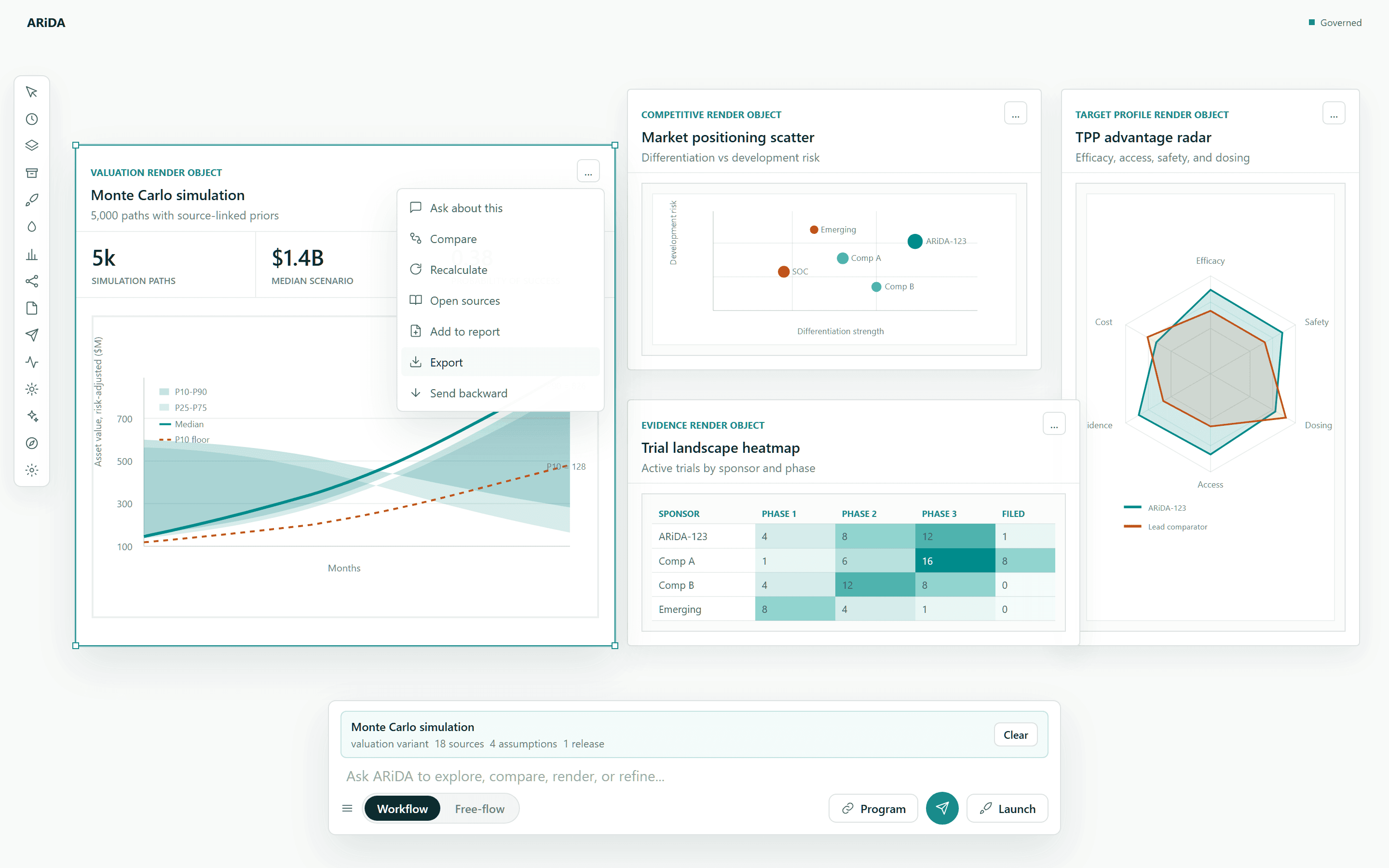
The case states the capital question and the options leadership can choose.
Support, contradictions, gaps and source rights remain visible.
Economics, transaction structure, scenarios and thresholds stay connected.
Owners, dissent, conditions and material change return the case to review.
Start with the capital decision
ARiDA begins with the alternatives, decision criteria, evidence requirements and unresolved questions. Whether the choice is to fund, license, acquire or reallocate, the case gathers and computes only what that decision requires.
Approve a capital action
The case ends in a capital action: fund, license, acquire, partner, defer or stop. Reviewers can inspect the evidence, assumptions, economics, alternatives and dissent before approval. The conditions that would reopen the decision remain explicit.
Why ARiDA
ARiDA makes the investment case executable. Evidence and transaction inputs flow into the relevant calculations, decision rules block unsupported conclusions and material changes reopen the case against the last approved baseline.
01
Evidence and thesis
Scientific, clinical, patent, competitive, commercial and execution evidence is judged against the claims that support the bet. Contradictions and missing evidence remain visible.
What changes
The case can strengthen, narrow or fail before attractive economics are allowed to dominate.
02
Economics and terms
Probability, cost, timing, revenue, deal terms, dilution, dependencies and portfolio correlation run through inspectable calculations and scenarios.
What changes
The team sees the value range, price ceiling, largest sensitivities, downside and cost of waiting.
03
Decision rules
Safety vetoes, admissibility rules, missing-data behavior, thresholds, approval rights and scenario assumptions remain explicit. A strong score elsewhere cannot cancel a serious liability.
What changes
A failed premise, breached threshold or missing requirement can block the recommendation and show why.
04
Continuous underwriting
ARiDA compares new evidence, economics and terms with the last approved baseline. It identifies the affected assumption, recalculates supported analyses and routes material changes to the responsible owners.
What changes
A material change can reopen the decision before stale assumptions consume more capital.
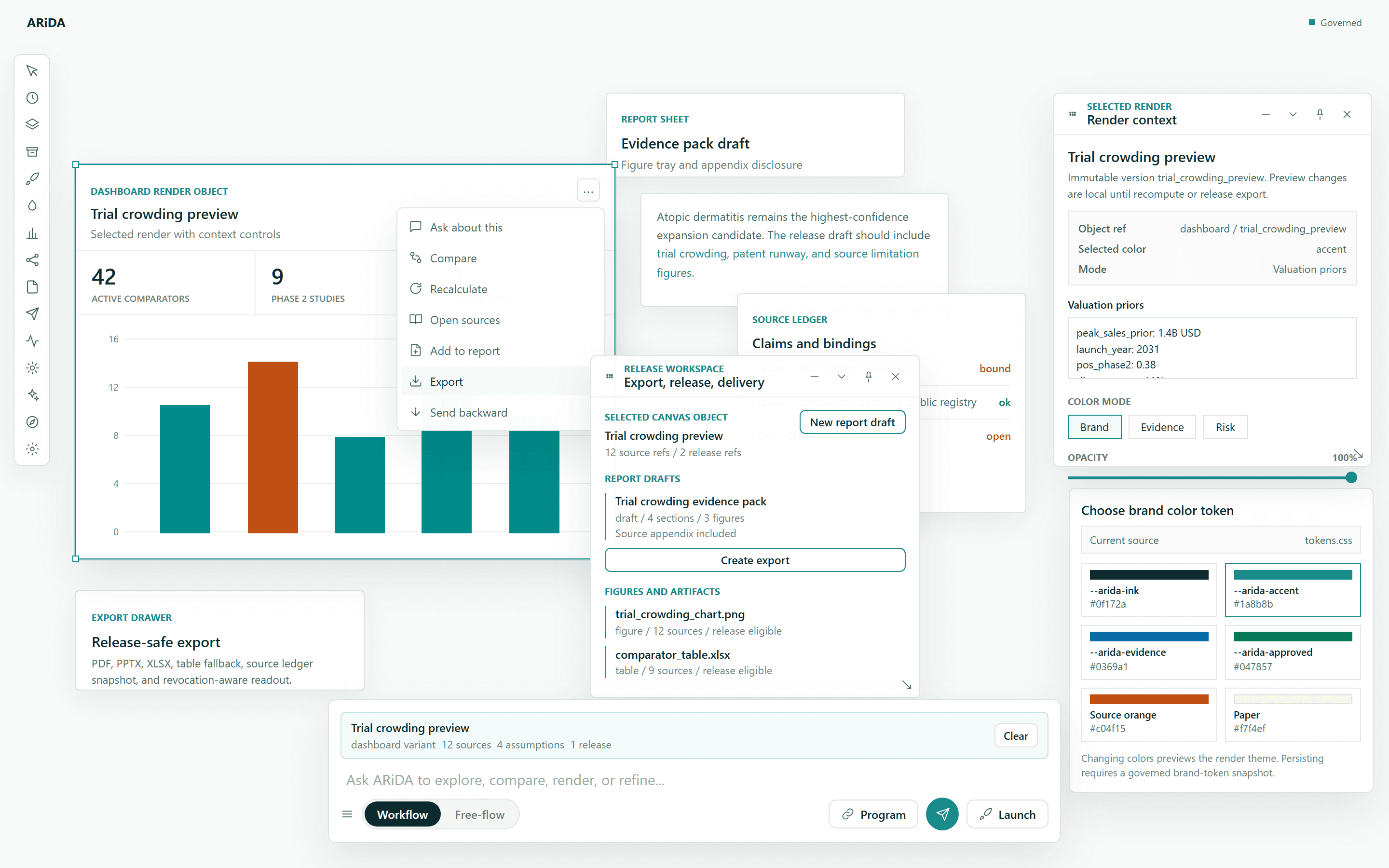
Each result shows what entered the case, what moved in the model and what it means for the decision. Teams can inspect the working analysis and release a committee paper, model, memo or deck from the same approved case.
Files are the release and handoff format, not the product itself. The Decision Case remains the record of the evidence, assumptions, calculation and approval behind each exported view.
Reviewed charts and conclusions arranged for a decision meeting.
Formulas, assumptions and sensitivities available for finance review.
A stable record of the analysis, caveats and approved recommendation.
Working copy for subject-matter and editorial review.
Machine-readable records for approved downstream use.
Specialist methods, one investment case
Studios bring scientific, financial, portfolio and patent methods into the same case. The capital decision determines the work required, while evidence, assumptions and asset context remain connected between methods.
Explore StudiosStudios are introduced through private enterprise engagements. Available methods depend on the decision, deployment configuration and permitted evidence.
Target opportunity
Does this target deserve the next investment?
Assemble target identity, disease biology, mechanism, tractability, safety and clinical precedent. ARiDA shows which evidence strengthens the thesis, which evidence blocks it and what should be learned next.
Open TargetAsset decisions
Should this asset advance, defer, stop, be licensed or be passed?
Keep molecular developability, mechanism, clinical evidence, safety, competitive analogues, regulatory context, IP evidence and business assumptions inside the same asset case.
Open DrugExpansion strategy
Where should this asset go next?
Compare scientific admissibility, clinical feasibility, differentiation, economics and execution constraints without hiding a weak dimension inside one composite score.
Open IndicationAsset and portfolio value
What is the defensible value range, and what moves it?
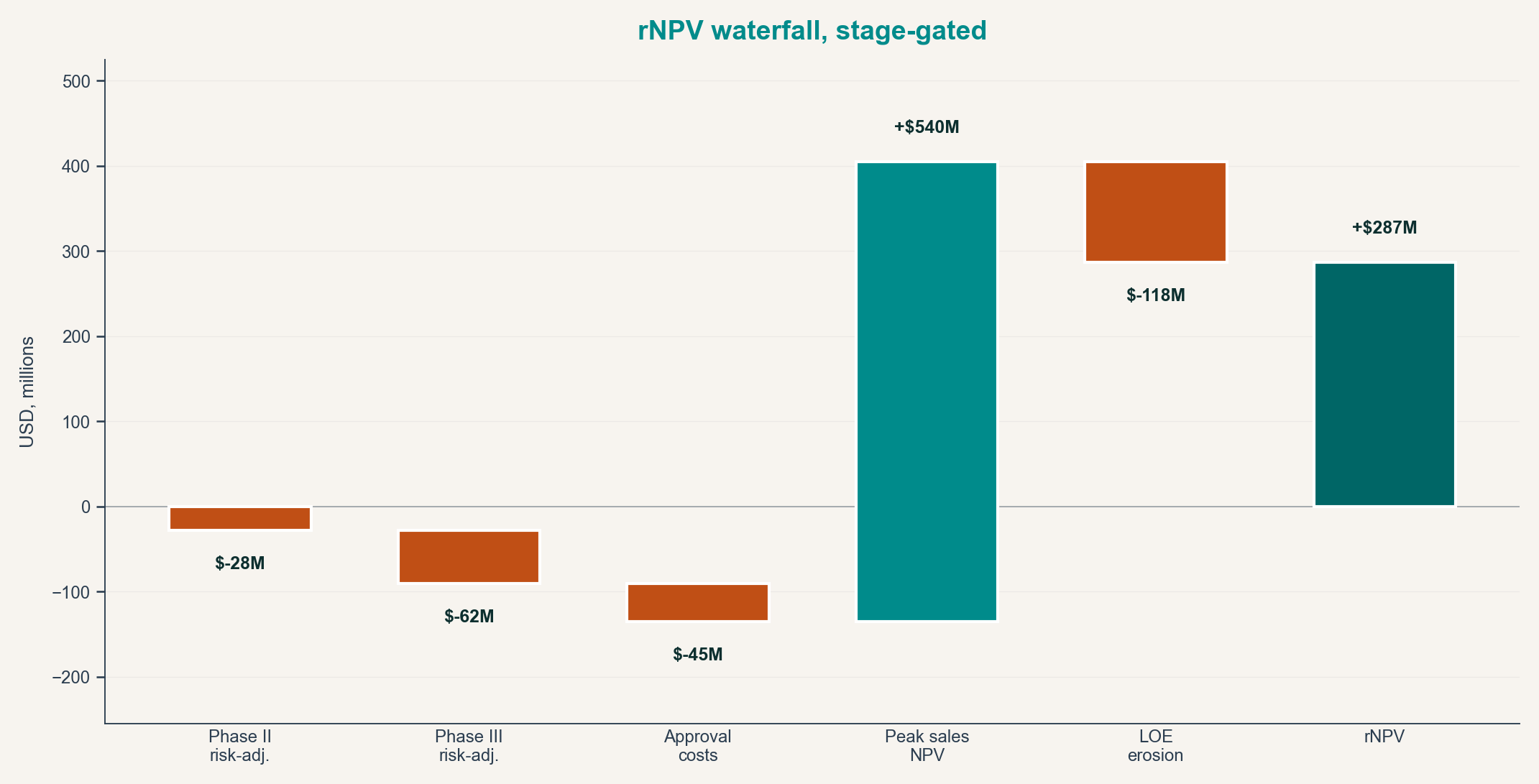
Connect scientific and clinical assumptions to rNPV, Monte Carlo distributions, real options and value of information. Reviewers can inspect an assumption and rerun the affected case.
Open ValuationCapital allocation
Which programs should receive capital now?
Evaluate assets against strategy, cash, capacity, shared scientific risk, timing and available options. Keep credible alternatives and dominated choices visible for the committee.
Open PortfolioIP evidence
Which IP evidence changes the business decision?
Connect patent-family, ownership, claim-theme, exclusivity and proceeding evidence to lifecycle, transaction and competitive questions. Patent Studio prepares evidence for business and counsel review. It does not provide legal opinions or clearance conclusions.
Open PatentARiDA relates scientific, clinical, competitive, commercial and transaction evidence to assets, assumptions and prior decisions. Sources remain inspectable, with rights and provenance carried into the investment case.
Evidence sources by topic: Targets: OpenTargets · UniProt · NCBI Gene; Drugs: ChEMBL · PubChem · FDA · EMA; Compounds & assays: ChEMBL · PubChem · customer evidence; Clinical trials: ClinicalTrials.gov · customer evidence; Patents & IP: USPTO · EPO · WIPO; Literature: NCBI E-utilities · PubMed · PMC; Diseases & evidence: Open Targets · ClinVar · literature; Companies & deals: SEC / EDGAR · NIH RePORTER · live web.
Continuous underwriting
Trial results, competitor moves, safety findings, costs, timelines, market assumptions and deal terms can all change the investment case. ARiDA tests new information against the approved baseline and returns material changes to the right owners.
Review where the team works
A trial result, safety finding, competitor move, cost revision, timeline change or deal term is attached to the investment case it may change.
ARiDA traces the new information to the relevant assumption, calculation and decision rule. The prior case remains available for comparison.
The case returns to the responsible owners when a scientific, clinical, commercial, financial or execution condition changes the approved posture.
Scheduled work and channel delivery can continue in the background. Messages, releases and consequential actions remain subject to the configured approval policy.
See how continuous underwriting works on a capital decision your team already reviews.
Enterprise deployment
ARiDA is configured around the customer's deployment architecture, access policy, data rights, retention requirements and approval process. Enterprise claims are evaluated against the exact deployment, not assumed from a generic product tier.
Decision governance
Each Decision Case records the evidence, assumptions, calculation, method version, unresolved gaps, approvals and release history behind the recommendation. When evidence is missing, the case records the gap and shows how it limits the decision.
Enterprise evaluation includes a review of deployment architecture, access controls, data handling, source rights and retention configuration.
Enterprise engagements
Select an internal program, licensing opportunity, acquisition target or portfolio question. We configure the underwriting method, evidence rights, decision controls and deployment around the work your committee already performs.
Biopharma commits capital across internal programs, licensing, acquisitions and portfolio moves, but each bet is often evaluated through a different process. That makes opportunities difficult to compare and leaves leadership without a common way to tell whether an approved bet still deserves capital when the facts change.